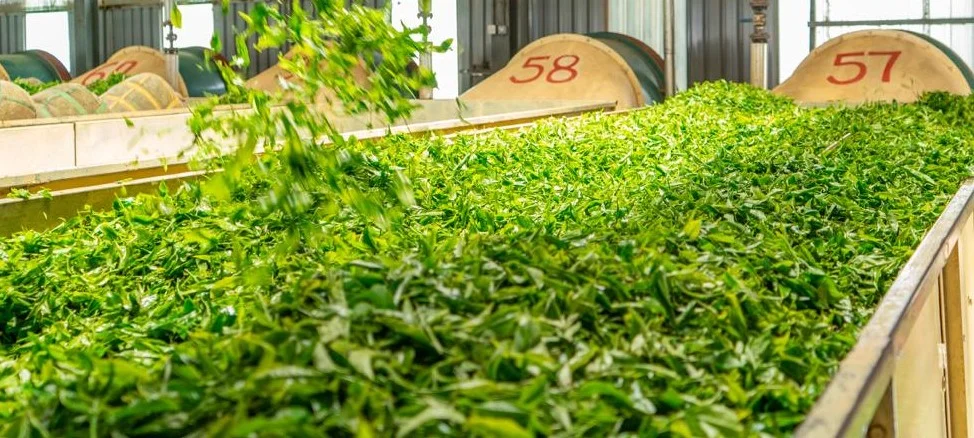
Walk through any tea estate in Kenya's Aberdare Ranges and you will see a single plant species carpeting the hillsides: Camellia sinensis. It is the same bright-green leaf that ends up in every one of our teas — black CTC, orthodox, green, and cottage specialties. The only exception is purple tea, which comes from a genetically distinct Kenyan cultivar. Understanding how processing transforms one raw material into four profoundly different cups is the key to appreciating the craft behind every Fusion Leaf product.
CTC: Crush, Tear, Curl
CTC is the most widely consumed style of Kenyan tea, and it is built for boldness. Fresh leaf is fed through a series of cylindrical rollers that crush, tear, and curl it into small, uniform granules. This aggressive cell rupture exposes maximum surface area to oxygen, driving a fast and complete oxidation that produces intense theaflavins — the compounds responsible for that brisk, coppery-bright liquor and full-bodied mouthfeel. CTC grades are classified by granule size: BP1 (Broken Pekoe 1), PF1 (Pekoe Fanning 1), PD (Pekoe Dust), D1 (Dust 1), Dust, and F1 (Fanning 1). Each grade brews differently, but all share that signature bold, malty character that pairs so well with milk.
Orthodox: Preserving the Whole Leaf
Where CTC is about power, orthodox processing is about nuance. The withered leaf is gently hand-rolled — or passed through a rolling table — to twist it without breaking the cellular structure apart. This preserves the leaf's structural integrity and allows oxidation to proceed slowly and unevenly, creating layers of flavour that unfold across multiple infusions. Our orthodox range spans grades from the large, wiry OPA and the tippy FOP (Flowery Orange Pekoe) down through OP1, Pekoe, FBOP, FBOPFSP, and the fine-particle FOF. The result is a smoother, more aromatic cup — woodsy, complex, and ideal for those who treat tea as a ritual rather than a refuelling stop.
Cottage and Specialty: Small-Batch Artistry
Our cottage and specialty line takes the craft even further. These are small-batch productions using handpicked leaf, processed with minimal intervention. White Silver Tea is barely oxidised at all — the buds are simply withered and dried, yielding a pale, ethereal liquor with sweet, hay-like notes. Our Green Tea is pan-fired or steamed shortly after plucking to halt oxidation, preserving the natural catechins and L-theanine that support metabolism and mental clarity. Then there are our flavoured blends — Hibiscus, Passion, Ginger, Lemon, Lemongrass, and Mint — where botanicals are married with a green or white base to create teas that are as fragrant as they are functional.
Purple: A Variety Apart
Purple tea stands alone. It does not start from the same green leaf; it comes from a unique Kenyan Camellia sinensis variety whose leaves are naturally flushed with anthocyanins — the same antioxidant pigments found in blueberries and red wine. The processing is gentle, closer to orthodox than CTC, and the resulting brew carries a subtle purple hue, a delicately sweet flavour profile, and a wellness story that no other tea on Earth can match. From one plant family, four radically different experiences — that is the magic of tea processing.